Debcraft is a tool that automates most of the repetitive and error-prone steps related to Debian packaging. It makes it easy to build .deb packages from source without having to manually prepare build environments. It clearly shows what changed in the build artifacts between two builds, automates parts of importing new upstream versions, and can automatically apply repetitive fixes to the packaging source code, including committing them in git.
While doing all of this, it also explains what it does and helps users learn best practices in Debian packaging, making the overall experience much easier and more fun than with any other tool before, while also being secure and fast.
Try out Debcraft 1.0 now!
Debcraft can be installed simply by running apt install debcraft on a recent version of Debian or Ubuntu. Check with debcraft --version that you have 1.0.0 or newer. The latest version can also always be installed from source at salsa.debian.org/debian/debcraft (does not require compiling anything).
Benefits
Debcraft was designed to offer the following three main benefits:
Easy
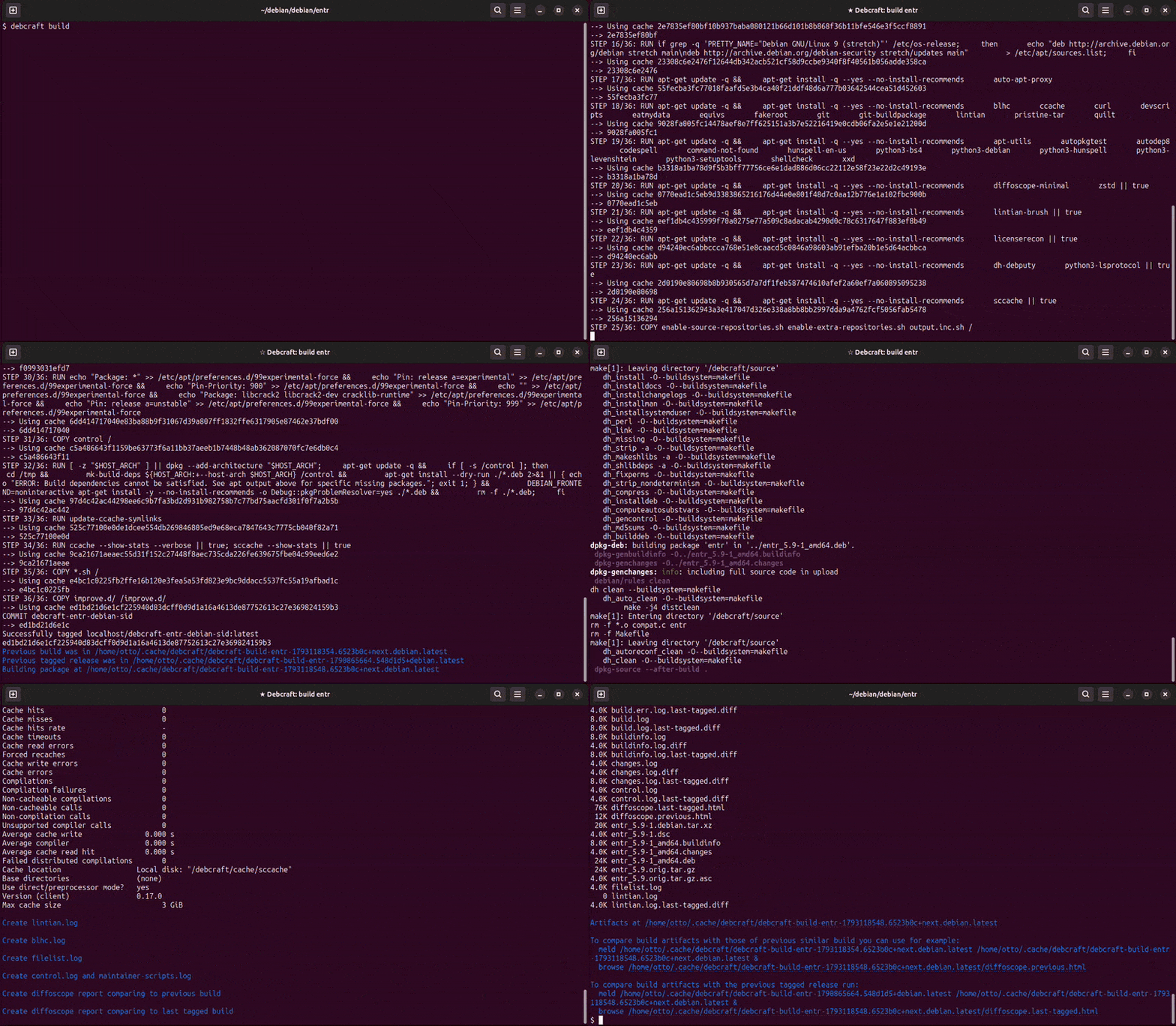
Build any Debian/Ubuntu package by simply running
debcraft buildin the checked-out Debian packaging git repository.If the orig upstream source code tarball is neither already present nor available on a
pristine-tarbranch, the exact upstream tarball is downloaded from the Debian archive.Users are spared from having to manually prepare ahead or maintain build environments. Debcraft builds create a container on-the-fly (both Podman and Docker supported), built using the target Debian or Ubuntu suite in
debian/changelogand with exact build dependencies fromdebian/control.Commands
debcraft improve,debcraft testanddebcraft updateautomate recurring package maintenance tasks and help maintainers produce high-quality, up-to-date packages, run Salsa CI, pass autopkgtest in Debian CI, and stay in sync across Debian archives and packaging git repositories.The command output is (relatively) easy to read, and it also teaches users about Debian packaging in context.
Fast
Container layer caching is utilized to make builds and re-builds blazingly fast.
If an apt-cacher-ng instance or equivalent is present, it will automatically be used.
Debian packages that support ccache or sccache build even faster.
Secure
The build phase happens inside hermetic containers with no network access. This ensures all dependencies are properly managed and that the built binaries are as trustworthy as the source code they were built from.
Using containers also protects the host system from getting polluted with extra development libraries, and adds an extra layer of protection to prevent anything malicious in the source code from accessing secrets on the host system.
The additional logs provided by Debcraft also help audit changes in Debian package sources and build artifacts.
See the Debcraft README.md for details on how this was implemented. I also previously wrote Debcraft - Easiest way to modify and build Debian packages, which explains the motivation and design in more detail.
Result of many years of development
The first commit in the git repository is from 2020 under the name debuildr. The project was renamed to Debcraft in a commit on December 8th, 2023. I have been developing this tool fairly actively since 2024 and using it for all my packaging, “dogfooding” so to say.
There have also been plenty of collaborators. In total, 13 people have contributed code across 21 MRs and PRs on Salsa.d.o, GitLab.com and GitHub.com.
Now, in October 2026, it was time to release Debcraft v1.0 as it has had extensive real-world use and iteration based on countless different packages and multiple users. Users have included both experienced fellow Debian Developers and lots of people who just started learning how Debian packaging works. As I mentor dozens of new contributors to Debian, I have seen that the latter group seems to benefit the most from Debcraft and its ease of use and built-in guidance, while to the more experienced developers the main benefit is having less details to remember and doing less mistakes.
Contributions welcome!
Try it: apt install debcraft, then run debcraft build in a checked-out Debian packaging repository. If you run into a problem, file a report or submit an improvement. New contributors can look for issues marked good first issue.
The code is intentionally written entirely in shell script to keep the barrier to code contribution as low as possible. It is also very easy to debug, as any command can be run with --debug to emit step-by-step information about what it is doing, and being Bash scripts, injecting set -x anywhere in the code will emit an even more detailed trace of every subcommand executed.
By the way, if you aspire to become a Debian Developer, and want to follow my examples in using state-of-the-art tooling and collaborate using salsa.debian.org, feel free to reach out for mentorship. I am glad to see more people contribute to Debian!